
2. John Wyclif
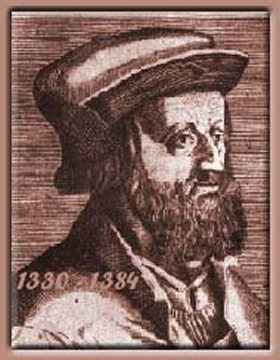 John Wyclif, known as the "Morning Star of the Reformation",
is born about 1325, roughly at the same time as Geert Grote, near Richmond
in the English county of Yorkshire. Little is known about his childhood.
From about 1345 onwards he studies in Oxford, where he stays for about
17 years. He dedicates himself in depth to theology and philosophy, interrupts
his studies for different reasons and finally gains his doctor's title
in 1372. But that is only the external account. The tracts and treatises
preserved from that time show a very well educated theologian who falls
back on earlier ideas reaching back to St. Augustin, unlike the governing
school of theology prevailing around him at the time, and who presents
these ideas with oversubtlety. During the last years before doing his
doctorate Wyclif already had the task of interpreting the Bible to students
- and that characterizes the way that still lay ahead of Wyclif: the Bible
becomes more and more important to him. To it no other work can compare,
thus his realization, for him it is "the mirror in which we are enabled
to see the eternal truths" (G.A. Benrath). In time he comes more
and more to conclusions herein which correspond to opinions of the Reformation
regarding the importance of the Bible. Due to his encouragement the Bible
is translated into English in 1382. According to Wyclif the role of the
sacraments, which according to Roman Catholic doctrine convey the presence
of Christ, is taken over by the Bible: people are transformed by reading
it.
John Wyclif, known as the "Morning Star of the Reformation",
is born about 1325, roughly at the same time as Geert Grote, near Richmond
in the English county of Yorkshire. Little is known about his childhood.
From about 1345 onwards he studies in Oxford, where he stays for about
17 years. He dedicates himself in depth to theology and philosophy, interrupts
his studies for different reasons and finally gains his doctor's title
in 1372. But that is only the external account. The tracts and treatises
preserved from that time show a very well educated theologian who falls
back on earlier ideas reaching back to St. Augustin, unlike the governing
school of theology prevailing around him at the time, and who presents
these ideas with oversubtlety. During the last years before doing his
doctorate Wyclif already had the task of interpreting the Bible to students
- and that characterizes the way that still lay ahead of Wyclif: the Bible
becomes more and more important to him. To it no other work can compare,
thus his realization, for him it is "the mirror in which we are enabled
to see the eternal truths" (G.A. Benrath). In time he comes more
and more to conclusions herein which correspond to opinions of the Reformation
regarding the importance of the Bible. Due to his encouragement the Bible
is translated into English in 1382. According to Wyclif the role of the
sacraments, which according to Roman Catholic doctrine convey the presence
of Christ, is taken over by the Bible: people are transformed by reading
it.
And it can achieve this because, according to Wyclif, Christ himself guarantees and vouches for the truth of the Bible. He fulfilled the law by his way of life and what he taught. Christ is the one who gave the commandments and he himself also fulfilled them. And it is the duty of Christians and the Church to follow this example. At the same time Wyclif especially emphasizes Christ's poverty, his humility and his patient suffering. The Church of Wyclif's time, however, fails to meet this standard, it has become too worldly, too complacent. Why? According to Wyclif because it does not take the Bible seriously enough. Therefore his suggestion of a therapy is as follows: expropriation of the Church, namely by the means of worldly force. Wyclif wants to change the existing system and therefore preaches a struggle against the possessions of the clergy. But Wyclif also speaks by way of theoretical texts. Wyclif opposes the enforced celibacy of the priests, the practice of indulgences, the last rites, requiems and also the veneration of saints - not one of these is prescribed by the Bible. The reaction is prompt: the "secular clergy" (i.e. the clergy who did not live in monasteries) took him to court in Rome - and he was condemned in 1377. But at the same time Wyclif was protected by th English state. More and more strongly Wyclif insists upon the right of the layman and the right of the state to point out the right way to a Church acting against the Gospels. The Pope is only to be obeyed in so far as he himself teaches properly and lives the right life, and this simply means: lives in poverty and propagates Christ's Law. The state, on the other hand, is to be obeyed because it is the authority appointed by God. The state must govern the people and ensure peace. Also regarding the understanding of the Lord's Supper he is critical, as far as the classical Roman Catholic understanding is concerned:
No priest, according to Wyclif, has the authority to transubstantiate the Eucharistic elements of bread and wine into the body and blood of Christ: wine remains wine and bread remains bread. It is all the more true that the Eucharistic elements remain in the state they are in but are nevertheless Christ's body and blood. But they are effective only if the distributors and recipients have a worthy attitude, that is only if Christian discipleship is also truly practised.
The criticism of Wyclif grows. His teaching about the
Lord's Supper is declared to be heresy. However Wyclif does not yield.
An attempt by his duke to move him to silence fails. This also leads to
tension between Wyclif and the authorities. Wyclif himself later also
includes all monastic life in his criticism of it not being compatible
with the Holy Scriptures. In 1382 the dispute reaches a climax; Wyclif's
teachings about the Lord's Supper, Church possessions and monastic life
are rejected. As a result followers of Wyclif run into trouble, whereas
Wyclif, who had withdrawn to a parish ministry, was himself not violated.
Wyclif, however, becomes more and more severe and bitter. He denies the
existing Church to be the Church. Instead the latter is to be found among
the faithful poor who follow Christ. The crusades were proof to Wyclif
of the Antichristian bearing of bishops and orders.
On 31 December 1384 John Wyclif dies after a second stroke.
Wyclif is a sharp critic of the Church of his time. He accuses it of secularization and demands reforms which, for most people, went too far. In his criticism of the existing Church and in his reverence for the Bible many of his statements are identical to those of the Reformation. For Wyclif the Church could be saved in the end by the repentance of the faithful and the Church and by their turning towards a Christian discipleship in poverty, humility and suffering. And Wyclif earnestly means this, he sees herein a practicable way, which indeed includes a noticeable change in constitution, doctrine and possession of the Church, and thus would have given the Church a completely new look. In 1415 Wyclif's teachings are condemned as being heretical by the Council of Constance which even carries out the execution symbolically by burning his remains.
Even if most of Wyclif's complex reform programme later fell into oblivion, still many of his impulses continued; for instance in the simple sermon of the so-called "Lollards" whom Wyclif during his life had already begun to send out as preachers. They later on influenced the English Reformation. But Wyclif also became an inspiration outside of England in Bohemia, namely to Jan Hus about whom we will talk in the next section.
Was Wyclif already an anticipatory Reformer? Yes and no. Yes, in his criticism of the Church of the Middle Ages, yes, from the point of view of the Reformation in the many aspects he emphasized in his reform programmes, yes, not least because of his very high regard of the Bible. But there is also the "No". What Martin Luther, for instance, said about "justification", that God in Jesus Christ saves mankind - Wyclif lacks this dimension for the most part. And as a result, from the point of view of the Reformation, he also lacks the possibility of qualifying human ability. Wyclif was a reformer of the Church upon whom the Reformation could build and carry on where he had left off.