
2. Childhood and Student Years (1509-1535)
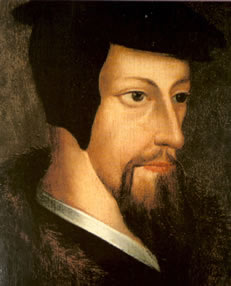 John
Calvin was born on 10th July 1509 in Noyon in Northern France (about
100 km north of Paris). His actual name is Jean Cauvin. Calvin’s
father was the notary of the cathedral chapter there and therefore a
layman among clerics and as such in a raised position. Already at the
age of almost twelve, John Calvin got his first living – a part
of the income of a particular parish (Chapel de la Gesine). Until 1523
Calvin went to school in his home-town. At the age of fourteen he was
sent to Paris to the College de la Marche, a famous boarding school,
at which Mathurin Cordier was head as Latin teacher. Cordier is known
as the founder of a new pedagogy. And even if Cordier himself only gave
Calvin Latin lessons for a short time, Calvin nevertheless admired him
his life long. And moreover, Cordier was later appointed head and organiser
of the school system in Geneva and Lausanne.
John
Calvin was born on 10th July 1509 in Noyon in Northern France (about
100 km north of Paris). His actual name is Jean Cauvin. Calvin’s
father was the notary of the cathedral chapter there and therefore a
layman among clerics and as such in a raised position. Already at the
age of almost twelve, John Calvin got his first living – a part
of the income of a particular parish (Chapel de la Gesine). Until 1523
Calvin went to school in his home-town. At the age of fourteen he was
sent to Paris to the College de la Marche, a famous boarding school,
at which Mathurin Cordier was head as Latin teacher. Cordier is known
as the founder of a new pedagogy. And even if Cordier himself only gave
Calvin Latin lessons for a short time, Calvin nevertheless admired him
his life long. And moreover, Cordier was later appointed head and organiser
of the school system in Geneva and Lausanne.
Only after a short time in the College de la Marche, Calvin moved in
1524 for unknown reasons to another boarding school, the College de Mantaigu,
a stronghold of Roman-Catholic orthodoxy, which was considered a nightmare
by the pupils. Nevertheless, Calvin seemed not to have suffered there
all too much, but rather to have enjoyed a thorough education, above
all in Grammar and in philosophy, but also in theology. Indeed, one of
Calvin’s teachers, John Mair or Major, has written a commentary
on the gospels and defended the Roman doctrines against Wyclif, Hus and
above all Luther. The doctrine of Luther had already got around and it
was this that had to be thoroughly defended against. Probably Calvin
got to know Catholic theology there on the basis of the Sentences of
Peter Lombard (c. 1100 to1160), the church fathers, and also from Augustine
(354 to 430).
Calvin made several friends, some of whom were open-minded in relation
to the Reformation, and some who even joined it. Calvin had not yet done
this himself – he found Luther’s polemic against Zwingli
too vehement. Whether Calvin had read Luther’s writings is unclear.
In any case, Calvin did not join the Reformation but remained for the
time being a faithful follower of the Roman Doctrine. One could describe
Calvin as a Catholic humanist who insisted upon a renewal of the sciences,
but not on a Reformation in the sense of Luther.
Indeed, in 1527, while Calvin was still at the college, the income of
a second living arose.
At the beginning, Calvin’s father had intended Calvin to study
theology. However, he changed his plan, perhaps because he had disputes
with the cathedral chapter in Noyon, perhaps also because he hoped for
more possibilities for his son from another discipline, and steered him
in the direction of law. Calvin began the study of law probably in 1528
in Orleans, then a very famous faculty. He worked doggedly and zealously,
learnt Greek in a few months and was influenced continually by humanist
ideals. Calvin left Orleans in 1529 and studied further in Bourges with
the famous lawyer Alciat.
In 1531, Calvin found out that his father had become seriously ill, travelled
to Noyon and was able to stay by his father in his last hours. The disputes
of Calvin’s father with the cathedral chapter had become so vehement
that he had been excommunicated since 1529, which insulted him greatly.
After the death of his father, Calvin went to Paris. He was now independent
and beside his juridical studies dedicated himself above all to literary
studies. In Paris, King Franz I had founded a new humanist-oriented university,
at which Calvin registered. In the Winter of 1531/32, Calvin composed
a commentary on Seneca’s “De clementia” – “on
mildness” (treatise). This book made him well-known and numbered
him among the leading humanist echelons in France. Then he returned to
Orleans and completed his study of law as “Licentiate of law.”