
5. The Building up of the Geneva Church
When Calvin returned to Geneva, his first sermon was a continuation of the last. He acted as if there had been no break. Calvin picked up seemlessly from his time in 1538. But his position in Geneva was now inevitably more powerful – he had been called back to order the town and church.
Calvin could not, however, achieve all this. He did not succeed, for
example, in getting the Lord’s Supper to be celebrated every Sunday.
The Bern regulation was adopted, according to which it only took place
every quarter of a year.
There were conflicts in other respects as well. Calvin wanted to introduce
church discipline further and to see it more widely practised. That is,
for the consistory to have the possibility to summon and question the
members of the community who were guilty of an offence against the doctrine
or morality, and if necessary to rebuke them, using excommunication at
the extreme. The town council, however, thought that that was going too
far, fearing a jurisdiction besides the political leadership. After some
argument, Calvin won through, but not without concessions and only fully
in 1555.
Today we find such kinds of church discipline problematic. For the rights
of the individuals seem thereby to be limited. This was not what concerned
Calvin. He was of the opinion that a community that knows who it is must
also respect how those who belong to it should behave, and that in the
event of flagrant infringements it must be asked whether real community
can be maintained. Incidentally, Calvin felt led and supported in this
respect by Matthew 18, where it speaks of the handling of offences of
members of the community.
The question of church discipline also led to the most conflicts with the Geneva council. More important in The Church Constitution, however, is the way in which the community itself is led. And in this regard, Calvin’s understanding of the fourfold office became influential in the life of the church. The church rule consists of four offices: the pastors, teachers, elders and deacons.
- The pastors are first of all to preach and teach, second, to administer
the sacraments (baptism and Eucharist) and third, to visit the sick.
Once a week the assembly of the pastors of the area met, interpreted
the bible together and practised reciprocal censorship.
- The teachers have the task of “instructing believers in the
salutary doctrine.” In the narrowest sense this is the explanation
of the bible, both Old and New Testaments. Because this involves both
knowledge of the languages and general education, such instruction
is also the task of the teachers, in order that “this instruction
brings gain.”
- Twelve elders were chosen each year by the two councils. Together
with six pastors chosen by their colleagues they made up the consistory.
This consistory had the task of keeping an eye on church order amongst the members of the church. The consistory and its members were to “admonish in a friendly manner those who they see slipping up or living in an disorderly manner.” The members of the consistory were thus concerned for the community’s way of life, but nevertheless also for participation in the services and doctrine. When they detected contempt or abuse, they were in the first place to admonish in all friendship. If this were not enough, they could effect excommunication and the reporting of an offence with the worldly authorities. Both happened extremely rarely, however. Most often the consistory was occupied in settling arguments, often between those who were almost allies. The consistory met once a week on Thursdays. The Church Constitution defines the spirit in which the consistory was to act, as follows: “All this should always be so moderate, however, that no oppressive severity can prevail, and equally the rebukes should be nothing other that a means of salvation, to lead the sinners again to our Lord.”
The consistory was neither supposed to intervene in the sphere of worldly power, nor in the general customary jurisdiction.
- The deacons have two tasks: support of the poor and caring for the sick. The first activity consisted in the organisation of alms and its distribution to the needy. To this there also belonged the feeding of the poor. The second consisted in the running of the hospitals and the hostel for foreigners. There was free treatment for the poor and a teacher was employed in the hospital for the children. (All quotations come from The Church Constitution.)
On church offices (from The Church Constitution of 1561) “There are four areas of responsibility or kinds of office,
which our Lord has created for the leadership of his church: first
the pastors, then the teachers, next the elders and fourth the
deacons. Therefore, if we want to have a well-ordered and unscathed
church, we must keep to this form of its leadership.” *** Questions for further Work: 1. How are the four offices defined? 2. Which office is given precedence? 3. Who leads the community? |

It thus becomes clear that inside the locally existing
community there are defined tasks to be to be seen to, such as those
belonging to the area of teaching and education, as well as others which
touch upon social dimensions. The offices in the community are to be
understood by these tasks, and that means in terms of function. This
functional understanding of office distinguishes Calvin from all sacramental
understandings. This is to be seen in the fact that one only holds office
as long as one performs it. The office is not bound to the person but
to the community. With this conception, clear distinctions from Lutheranism
become nameable. In the latter, there is a concentration on the one ordained
office of proclamation and administration of sacraments, which is bound
to the person and not to the community.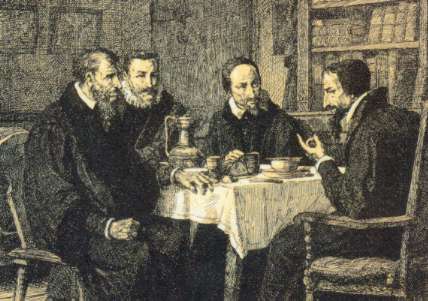
Farel, Beza and Viret with Calvin
Besides his activity in Geneva, Calvin was called upon to unite the different Protestant movements. In respect to the Lord’s Supper, he reached an agreement in 1549 with the people of Zurich in the so-called “Consensus Tigurinus” (Zurich Consensus). It was actually here that something like a “Reformed understanding of the Lord’s supper” first arose.
On the Understanding of the Lord’s Supper. (Passage from Institutes IV, 17, 1-2. Trans. Ford Lewis Battles, ed. John T. McNeill, Vol. 20 and 21 in The Library of Christian Classics, London: SCM press, 1961). [God] has willed, by giving his pledge, to assure us of this continuing
liberality. To this end, therefore, he has, through the hand of
his only-begotten Son, given to his church another sacrament, that
is, a spiritual banquet, wherein Christ attests himself to be the
life-giving bread, upon which our souls feed unto true and blessed
immortality [John 6:51]. … *** Questions for further Work 1. What is the point of the Lord’s Supper? 2. Who is fed in the Lord’s Supper? To whom does the Lord’s
Supper give something? 3. Are the bread and wine the body and blood of Jesus Christ? 4. Is the Lord’s Supper necessary for salvation? |