
11. East Germany
In today’s East Germany, there appear to have been two different
courses of events.
The course of events in the Principality of Anhalt resembles some of
the types of Reformed confessionalisation which have been described up
to now. The Reformation was introduced in several small stages up to
1545. Within the Lutheran doctrinal disputes after Luther’s death,
Anhalt tended towards the orientation of Melanchthon. And from 1580,
the princely house, which was connected to the Palatinate and the House
of Orange, carried through the gradual transition to the Reformed Church.
The most important theologian was Wolfgang Amling, who drew up the “Anhalt
Confession” (of 1579). In 1603 the principality was divided up.
From 1644 on the princely house of Anhalt-Zerbst carried through a re-Lutheranisation
of this part-region. In Brandenburg, however, the Reformed confessionalisation
progressed differently. The Elector of Brandenburg John Sigismund accomplished
his conversion to the Reformed confession at Christmas in 1613. However,
unlike in almost all other regions, this conversion did not affect the
whole of the territory, but only the ruling house and its nearby surroundings.
The principality itself remained Lutheran. Thus, the principle “cuius
regio eius religio” was broken. The reasons for why the Elector
did not demand his land to become Reformed are not wholly clear. One
the one hand, John Sigismund’s tolerance is emphasised, but on
the other stands the suspicion of political calculation.
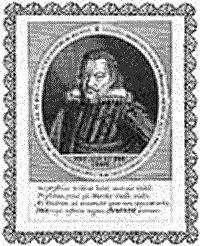
Kurfürst Sigismund
In 1614 the “Confessio Sigismundi”, which brought out several
Reformed emphases, appeared, and became Brandenburg’s binding confession
for the Reformed. About twenty Reformed so-called court congregations
and court chaplains arose before the death of Sigismund (e.g. in Crossen,
Koepenick, Landsberg and Kolberg). The existence of these congregations
and of the Reformed ruling house led to numerous refugees coming to Brandenburg
after 1648 (above all Huguenots).
Some of the formerly Reformed court congregations continue to exist as
Reformed congregations and others have merged with Lutheran congregations
to form Protestant congregations in the “Protestant Church of Berlin-Brandenburg.”