
2. Martin Bucer and Strasbourg
Martin Bucer and Strasbourg belong to the “History of the Reformed Church” only in certain respects. For the so-called Upper German Reformation actually embodies an independent type besides the Lutheran and Reformed.
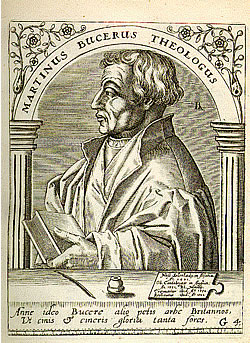 |
Martin Bucer Boissard, Jean-Jacques; Bry, Theodor de: Bibliotheca chalcographica, hoc est Virtute et eruditione clarorum Virorum Imagines. Heidelberg: Clemens Ammon, 1669. Partes 1-5: 1669, S. 35 |
Martin Bucer (actually Butzer) was born on Nov. 11, 1491 in Schlettstadt
(Alsace). 15 years old, he became a Dominican novice, studied theology
in Heidelberg, left the monastery in1521 and became first a priest. Far-reaching
for Bucer was his participation in Luther’s Heidelberg disputation
in 1518. Since then, Bucer’s theology was shot through with the
message of justification. In the years of 1521 to 1523, Bucer entered
the company of Franz von Sickingen, a knight inclined to humanism, became
a pastor in Landstuhl and Weissenburg, married the former nun Elisabeth
Silbereisen and was excommunicated by the Bishop of Speyer in 1523 on
account of the marriage and Reformation preaching. He moved to his hometown
Strasbourg and was chosen to be a pastor there in 1524. He pushed ahead
in unmistakable steps the Reformation that had already been introduced
there (among those who worked there was Wolfgang Capito). In this way
he developed his own theological character, which in the same measure
both joined him to Luther and separated him from him. The basic trends
of the doctrine of justification are especially present in Bucer: the
human cannot redeem himself – he is a sinner through and through.
However, (and here Bucer makes other emphases than Luther) this does
not mean that the believing human being, who knows that God’s grace
alone saves him, is permitted to sit back and do nothing. Rather, the
Spirit of God qualifies believers for the service of neighbour – and
leads them to various reforms in the church and society. Only a few years
after the beginning of his activity, at the beginning of the thirties,
Bucer was already considered the most important Reformer of the Southern
German towns. He became the adviser of Philip of Hesse, one of the regional
rulers to be numbered among the forerunners of the Reformation in Germany.
Bucer was principally interested in the uniting of the various Protestant
camps. He worked intensively (and ultimately without success) on an agreement
in the understanding of the Lord’s Supper between the reformers
of Wittenberg and of Zurich (to whom he stood somewhat nearer). Luther
did not accept Bucer’s in-between position. And further, after
Bucer’s death, Zurich rejected his efforts towards unification.
Luther ultimately succeeded in moving Wittenberg and the Protestant Southern
German territories (which were threatened by isolation) towards a (more
formal) agreement in respect of the Lord’s Supper (Agreement of
Wittenberg in 1536). The result was that the Southern territories in
the majority turned towards Lutheranism.
Throughout his endeavours towards an inner Protestant consensus, Bucer
was also engaged as a prominent figure in the so-called religious colloquies
in Hagenau, Worms and Regensburg (1540/41), which had the goal of a unification
of, or at least an agreement between, the Protestant and Catholic churches.
These colloquies failed however. Meanwhile, Bucer continued his activity
of reform in Strasbourg – and for some in Strasbourg he went too
far. In 1548 Bucer had to leave Strasbourg and went to England, where
he sought from Cambridge (where he did his doctorate of theology) to
foster the Reformation in England. He never felt at home in England however,
and died in 1551. His bones were burnt in 1557 in the context of the
temporary re-Catholicisation under Queen Mary in the market square of
Cambridge. Three years later, however, Bucer was ceremoniously rehabilitated
by Queen Elizabeth I. Two years later, a co-worker of Bucer for many
years, Conrad Hubert, wrote about Bucer, “… among the faithful
servants of Christ … he was in no way the least.” Bucer’s
untiring dedication to the achievement of an agreement between the various
camps and his ceaseless activity had effects which lasted long after
his death. Bucer’s theological significance was discovered anew
in the 20th Century.