
6. Lippe
The development of the Reformation in the County of Lippe began as early as the beginning of the fifteen-twenties. Above all, there arose in the town Lemgo (also however in Salzuflen and Blomberb) a local movement that, as early as 1533, led to the town’s becoming Protestant, the Church Constitution of Brunswick of the Reformer Johannes Bugenhagen being introduced in the town. The Protestant movement could not spread throughout the whole of the county, however, since the Count Simon V remained Roman Catholic. After his death in 1536, his still under-age son, Bernhard VIII, became his successor. There were at the time two competing powers trying to influence Lippe: the Catholic Paderborn and the Protestant Hesse. Bernhard’s guardian, Landgrave Philip of Hesse, succeeded and so the Reformation was introduced officially in the whole of Lippe in 1538. In the same year, a new church constitution was drawn up by the Bremen theologians Adrian Buxschoten and Johann Tiemann, which was even reported on positively by Melanchthon. At the same time, a visitation by the Lower Saxon Reformer Antonius Corvinus in 1542 brought about that the Reformation had in many places not yet properly gained a foothold.
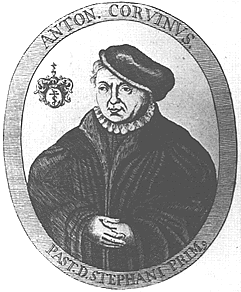 |
Corvinus |
In the Augsburg Interim in 1548, there was an attempt by Paderborn to re-catholicise Lippe, which nevertheless remained unsuccessful. Only after the Religious Peace Treaty of Augsburg in 1555 can one say that the Lutheran Reformation became generally established in Lippe. In 1571 there arose a new church constitution, which completed the first one from 1538. It keeps to the Augsburg Confession of 1530 and includes both instructions for the church service and for everyday life. In the meantime, Bernhard VIII had died in 1563. His son, Simon VI, born in 1554, became his successor and turned towards Melanchthon-Reformed convictions (perhaps because of the family circumstances on his mother’s side, but possibly above all on the basis of his study in Strasbourg with Johannes Sturm). During his educational tour, which also led him through the Netherlands, he came in contact with the Reformed theologian Menso Alting in East Friesland and with Christoph Pezel in Bremen, both of whom impressed him. When Simon VI took over the government businesses, he very gradually began a reworking towards the Reformed Reformation. For him this was no new reformation, but rather a continuation of what had already existed in Lippe for almost 60 years. He did not want to introduce any strict Calvinism in Lippe, but rather sought the balance between the various Protestant orientations. In the year of 1600, a consistorial constitution was drawn up on the instructions of Simon VI by Dreckmeier, the Chief Superintendent of Detmold, modelled on the Reformed Church Constitution of the Electoral Palatinate.
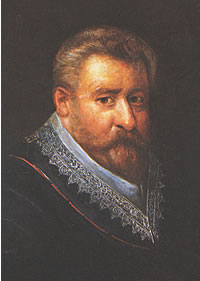 |
Simon VI. von Lippe |
However, it was only in 1605 that Count Simon VI and his family, in
the Detmold market church, received the Lord’s Supper according
to the Reformed rite. By 1612 all the congregations in the County of
Lippe except Lemgo had become Reformed, though a negative attitude certainly
arose among the church people in many places. The majority of the pastors
nevertheless gave their support to the Reformed confessionalisation.
The steadfast refusal of the town Lemgo to become Reformed was successful.
They retained the right to remain Lutheran (“Roehrentruper Rezess” 1617).
Simon VI died in 1613. His successors reigned only briefly and did not
create many new impulses. In the foreground there stood the terror of
the Thirty Years’ War. It was only in 1684 that the “Christian
Church Constitution of the County of Lippe” appeared, a church
constitution originating from the General Superintendent, Jakob Zeller,
in which tasks and functions of life in the congregations are set out
and described. The character of this church constitution is uplifting – a
pietistic streak pervades this text, which is still officially valid
in the Church of Lippe today. The Regional Church of Lippe today is Reformed
in character with a Lutheran division.
From the Christian Church Constitution of 1684 (Lippe) From the preamble From Article 24: *** Questions for further work 1. The Church Constitution of Lippe of 1684 came into force on
9th June 1684 at the instigation of Count Simon Henry. In its form
it is typical and expressive of the “princely Reformation” in
Germany. How does the Preamble see the function of the counts in
relation to the church? 2. What role of the preacher is discernible in Art. 24?
|
