
2. The Development of the Reformed Church in France after 1598
In the year 1598 (for the time before 1598 see lesson 3) the French King Heinrich IV published the Edict of Nantes. This decree resulted in a period of relative peace amongst the French Reformed Protestants. Heinrich IV, who was only able to become king on the condition that he gave up his own Reformed confession, can in certain respects be seen as the patron of the Reformed Protestants. For with the Edict of Nantes, the principle “cuius regio eius religio” (he to whom the land belongs also determines the religion of his subjects) was broken for the first in a European country, and a confession other than the Roman-Catholic obtained the right to exist. France had become a multi-confessional state.
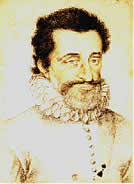
Heinrich IV.
(1551-1610)
From the “Edict of Nantes” of 1598 18. We also forbid all our subjects…to kidnap by force or through encouragement against the will of the parents children of the said religion, in order to baptise or confirm them into the Catholic, apostolic and Roman Church… 19. Those of the named R.P.R. should not be forced into anything, nor bound on account of previous renunciations, promises and oaths …They should therefore not be bothered or pestered in any conceivable way. 21. Books concerning the said R.P.R. must only be published and sold publically in towns and places where the public practice of the said religion is permitted. *** Questions for further work 1. What does the Edict of Nantes require of the members of the
Roman-Catholic Church? 2. What does the Edict of Nantes say to those who have revoked
their Protestant confession in the course of the Counter-Reformation? 3. Is it possible to speak of an equality of status between the
Reformed and Catholic churches?
|

Admittedly the two confessions did not have equal status, but the Reformed
Protestants were granted certain things: they were allowed to hold church
services in a large number of places; they were allowed to build churches
and schools and even academies (for instance in Montauban, Sedan and
Saumur). They did not simply have to hand over their former garrisons,
but were allowed to keep them for several years. In the first half of
the 17th Century there were roughly 850000 Reformed Protestants, which
corresponds to ca. 4 percent of the whole population. The Reformed communities
arose above all in Normandy, in the area of La Rochelle on the Atlantic,
in Languedoc and in the Cevenol in the South of France. The nobility
was strongly represented – a fact which should not be underestimated
as a reason for the tolerance of the state.
Over against these concessions of the state there was a distrust of the
new religion on the part of many of the French people, which continually
came to expression in assaults and persecutions. There were also substantial
groups in the political leadership of France that considered Heinrich
IV to be wrong. After the murder of Heinrich IV in the year 1610, the
climate changed increasingly to the disadvantage of the Reformed Protestants.
Heinrich’s successor, Ludwig XIII, who for reasons of his age effectively
came into power only in 1617, worked with the aim of a provisional political
stabilisation in France, but never left it in doubt that he was ultimately
interested in the elimination of the Reformed Confession. His minister,
Richelieu, thus saw to it that in 1629 the religious freedom of the Edict
of Nantes was once again endorsed. This happened, however, against the
background of the increasing number of individual persecutions. After
the death of Ludwig XIII, Ludwig XIV, known as the Sun King, came to
the French throne. For reasons of his age he reigned only from 1661.
And from 1659 the policy regarding the Reformed Protestants markedly
changed. In the first place, the general synods were forbidden. Oppressive
measures followed: church services were monitored; parents were still
only given a limited power of decision in the matter of the religion
of their children; those who converted to Catholicism were granted privileges;
Reformed Protestants could no longer take up all professions. More and
more often there were violent malpractices against Reformed families,
which the state authority either tolerated or overlooked.
Finally in the year 1685 the Edict of Fontainebleau was published – the
Revocation of the Edict of Nantes. Thereby the Reformed Protestants in
France were deprived of all their hitherto existing concessions. From
then on all children had to participate in Roman-Catholic catechism.
The Reformed churches were destroyed and the pastors exiled. Everyone
else, however, was forbidden from leaving the land. This also had economical
reasons on the part of the state. Failure to comply was threatened with
the galley.
From the “Edict of Fontainebleau” of 1685 2. We forbid our subjects of the R.P.R. to meet any more for the exercise of the said religion in any place or private house, under any pretext whatever,… 3. We enjoin all ministers of the said R.P.R., who do not choose to become converts and to embrace the Catholic, apostolic, Roman religion, to leave our kingdom and the territories subject to us within a fortnight of the publication of our present edict…on pain of being sent to the galleys. 9. We repeat our most express prohibition to all our subjects of the said R.P.R., together with their wives and children, against leaving our kingdom, lands, and territories subject to us, or transporting their goods and effects therefrom under penalty, as respects the men, of being sent to the galleys, and as respects the women, of imprisonment and confiscation. *** Questions for further work 1. Does the Reformed Church have the possibility of survival
in France? 2. Preachers must leave the country whilst others are not permitted
to emigrate. Why is this distinction made?
|
This arrangement of Ludwig XIV had catastrophic consequences for the whole of the Reformed Church in France. There were numerous conversions, even among the pastors. Many of these, however, were sham conversions. Others resisted, some even by force of arms. More than 1500 Reformed Protestants were sentences to the galley. Above all, however, there began after 1685 a massive flight of many of the Reformed Huguenots. Ca. 200000 people secretly fled abroad, above all to Switzerland, the Netherlands, England and various German countries (above all Brandenburg – see lesson 4).
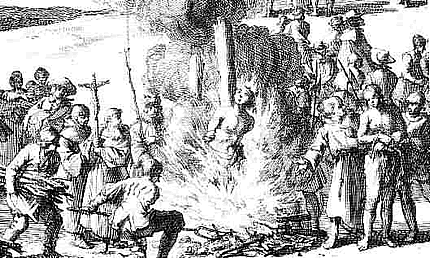
The persecution of the Huguenots
The Reformed Church in France was therefore weakened, but not, however,
destroyed. It lived on underground in the years following 1685, and formed
the “Church in the desert.” Above all, the Huguenots in Cevenol
met secretly for church services. Hopes for the retraction of the Edict
of Fontainebleau were shattered, and there subsequently arose between
1702 and 1704 a large revolt in the South of France, which also became
known as the Camisards War or Cevenol War. At any rate, it became clear
in the course of this that the aim of the French state to root out the
Protestants had failed. In the first half of the 18th Century the persecution
of the Reformed Protestants was no longer carried out so systematically
or to such a great extent. Phases of relative quiet alternated with persecution
and oppression. There were scarcely any Reformed Protestants in the towns,
but the communities continued to exist in the country, often holding
church services in the castles of Reformed nobility. From 1750 a reorganisation
of the Reformed Church began and synods were held. Finally in 1787, a
good hundred years after the abolition of the Edict of Nantes, the Reformed
Protestants were awarded full citizenship.
By the time of French Revolution in 1798, the Reformed Church in France
had grown to almost a million members. Although the French Revolution
had first of all granted religious freedom in its constitution, the radicalisation
of the French Revolution in 1793 led to the oppression of the Reformed
Church. This brief episode caused a considerable weakening of the Reformed
Church. From the 205 pastors of the time before 1789, there were only
120 left in 1794 when the reconstruction of the Reformed Church was undertaken.
At the beginning of the reign of Napoleon I in 1799, the situation changed.
Although Napoleon granted the Protestants the right of existence, he
simultaneously opposed the independence of the Church. No national synods
were planned. The Church was divided up by the French State into districts – 80
consistorial churches, each with about 6000 members. This had the consequence
that many formerly independent parishes were integrated into larger units,
for local parishes were not recognised legally. The pastors were paid
by the state and conversions were not allowed. The state regulated the
church life. As a counter-movement to the strong influence of the state,
there arose from 1817 the revivalist movement (Reveil), which led to
the establishment of new communities. After 1848 this revivalist and
evangelistic movement was fostered above all by societies independent
of the church and in part also free churches. An integration of these
new communities into the French Reformed Church succeeded only in a few
cases. The lack of a national synod also led to a situation in which
various currents within the Protestant Church were able to break free.
A union was called for and in 1872 the first French national synod since
1559 was convened. However, instead of achieving unification, this led
to an official separation. The former Orthodox Reformed Protestant Church
(Eglise réformée évangélique) and the Liberal
Reformed Church (Eglise réformée) existed alongside one
another and each held their own independent synods.
In 1905 the Federation of Protestant Churches in France (Fédération
Protestante de France), to which all Protestant churches in France belonged,
was founded. The rapprochement of the various Reformed churches led in
1938 to the formation of an alliance and thus to a reestablishment of
the Reformed Church in France.
Today this Reformed Church has roughly 180000 members in 350 parishes.
Besides this there is also the Reformed Church of Elsass and Lothringen,
which has roughly 33000 members in 52 parishes. Since Elsass and Lothringen
only later became parts of France, the Reformed Church developed rather
differently in these places. Here there is also a strong Protestant-Lutheran
Church, with which the Reformed Church of Elsass-Lothringen is in close
cooperation.