
6. The Protestant Church of the Bohemian Brothers
In Bohemia and Moravia there existed at the time of the Reformation the “Bohemian-Moravian Unity of the Brethren” of above all Hussitic origin, which had also integrated Waldensian and other traditions. There were contacts between Brother Luke, who had influenced the Unity of the Brethren at the beginning of the 16th Century, and Martin Luther. However, in the context of the confessional conflicts the Unity of the Brethren developed more in the direction of the Reformed Church. From 1618 on Bohemia and Moravia were forcibly re-Catholicised, after the imperial Habsburg troops had beaten the Bohemian army. 27 spiritual leaders were executed and mutilated. Over 1200 pastors had to leave the country. More than 360000 families left with them and the population was reduced to a third. The hitherto heyday and the affluence of the country were thus brought to an end. Besides Saxony, Silesia and Poland were also destinations of emigration. Another proportion went into the underground. In Poland Jan Amos comenius was the most important theologian and senior in the 17th Century. The “Patent of Toleration” of 1781 of the Habsburg emperor Joseph II once again permitted the Protestant Confession. And subsequently roughly 66000 Czechs joined the Reformed Church. By 1789 73 parishes had been founded.
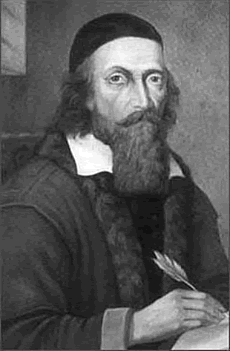
Jan Amos Comenius
(1592-1670)
From the “Patent of Toleration” of Emperor Joseph II (1781) Convinced on the one hand by the harmfulness of all coercion of conscience and on the other hand of the great benefit for religion and the state of a true Christian toleration, we have found ourselves persuaded to allow adherers to the Augsburg and Helvetian confessions to perform a religious practice appropriate to their religion….The Roman-Catholic religion alone should continue to have precedence in regard to public religious practices. 1. … Concerning the churches, we expressly enjoin, where it is not already so, that there should be no bell ringing, no bells, no towers and no public entrance from the street… 7. Non-Catholics are permitted real estate and property, rights of citizenship and craftsmanship, academic titles and civil employment…and they are to be urged to no other oath than to that which is appropriate to their religious principles, nor to the attendance of the processions or functions of the dominant religion… *** Questions for further work 1. What understanding of toleration can be seen in this Patent
of Toleration? Is it identical with today’s understanding
of toleration or can it be distinguished from this? 2. Why are the Protestant churches (Augsburgian = Lutheran, according
to the Augsburg Confession of 1530; Helvetian = Reformed, according
to the Second Helvetian Confession of 1566) entitled both existence
and church services, but nevertheless only a limited public space? 3. Are there distinctions between the Catholics and Protestants
in respect to their rights of citizenship?
|

However, the confessions never gained equal status. The Protestants, for example, also had to pay the Roman-Catholic priests. Protestants were allowed to exist but were not liked by the state. Up to 1861 the Reformed Church grew more slowly than the population – only five parishes were added. In this year the emperor Franz Joseph I passed the so-called “Protestant Patent.” The Protestants now obtained equal rights and the Lutheran as well as the Reformed Church grew extensively. In the year 1919 the Reformed and Lutheran churches united to form the “Protestant Church of the Bohemian Brothers” – the name expressing a continuity of the Bohemian history. In the following years many former Catholics joined this Church. After 1945, however, the Church became considerably smaller. 13000 members among 264 parishes belong to the “Church of the Bohemian Brothers” today. Important for the Church is the Comenius Faculty in Prague.