
5. Confessions from German Regions
The first confession on German soil was the East Friesian Confession of 1528, which was also called the Preacher’s Confession. There were Reformational activities in East Friesland from 1520, influenced more by Zwingli than by Luther. This Zwinglian position, above all recognisable in the doctrine of the Lord’s Supper, finds expression in the East Friesian Confession, which consists of a “summary of the Christian doctrine of the preachers in East Friesland” in 33 articles. On the part of the authorities this confession was never officially introduced, since the preachers in 1528 were free in their doctrine. Nevertheless, it had regional, if only regionally limited, significance.
Alongside the Confessio Augustana, the most important Lutheran Confession, and Zwingli’s Fidei ratio, the Confessio Tetrapolitana (Four Cities Confession) was drawn up for the Reichstag in 1530 to represent the position of the Upper German Protestants. It was influenced both by Luther and by Zwingli, and seeks in the doctrine of the sacraments to mediate between them. On the instructions of Strasbourg, which Memmingen, Lindau and Kanstanz followed, Martin Bucer and Wolfgang Capito formulated a text which was never read out at the Reichstag.
In 1554 the Small Emden Catechism was published, following a larger one from the year 1546. Both were composed by Johannes a Lasco, who was dean in East Friesland from 1543 to 1549 and spent time in Emden again from 1554 to 1555. Whereas the older catechism was only in force for a short time, partly for the reason of its length, the later one, in 94 concise paragraphs, was utilised “for the benefit of the youth in East Friesland,” in the words of the title of the Catechism. The Small Emden Catechism was in use in East Friesland well into the 20th Century.
The most important Reformed confession that arose on German soil is the Heidelberg Catechism, which appeared in 1563 in Heidelberg. In the Electoral Palatinate the Lutheran Reformation was introduced in stages up to 1560, during which strict Lutherans, followers of Meanchthon as well as those of Reformed conviction existed side by side and not altogether free of tension. The Elector Friedrich III, who reigned from 1559 to 1576, confessed, for the sake of unity, to one position. Above all on the basis of the conception of the Lord’s Supper this was the Reformed. His aim was to take up Lutheran and Melanchthonian concerns. The document of this attempt at reform is the Heidelberg Catechism. The question of who composed it is even today not finally resolved. The most important author is probably the Heidelberg professor of theology and pupil of Melanchthon, Zacharias Ursinus (1534-1548); the co-authorship of Kaspar Olevian, which has been asserted until recent times, is disputed.
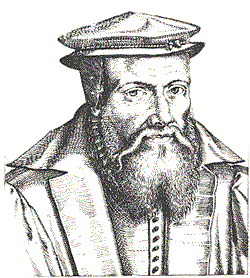
Zacharias Ursinus (1534-1584)
The intention of the Heidelberg Catechism was to unite the conflicting Protestant movements in the Electoral Palatinate. In many sections both Lutheran and Reformed emphases are therefore to be perceived. This is already the case in question and answer 1. Inquired after is the unique comfort in life and death – a question inspired by Lutheran theology, directed at those who seek comfort. The answer, on the other hand, contains more strongly Reformed traits insofar as it does not directly introduce justification, but refers to the one who justifies, in whose hands the questioner finds him/herself: “ … that I do not belong to myself but rather to my faithful saviour Jesus Christ.” The further statements in question and answer 1 then describe the activity of Jesus Christ. This example shows (as would many further texts) that Lutheran concerns are often integrated into a Reformed structure. However, many important statements of Calvin (e.g. his doctrine of predestination) are not taken up.
Question and Answer 54 of the Heidelberg Catechism What believest thou concerning the “holy catholic
church” of Christ? *** Questions: 1. Here, as in other texts from the time of the Reformation (and
not only there), we find the statement of “election.” How
is this concept used in answer 54 of the Heidelberg Catechism? 2. From when does the Church exist, according to the Heidelberg
Catechism? And until when? And what could this mean? 3. How does the Heidelberg Catechism define the relation between
community and individual community member?
|

In principle everything is already contained at core in question and answer 1. The three sections: 1. Of human misery (3-11), 2. Of human redemption (12-85), 3. Of human thankfulness (86-129), interpret the first question and answer. The Heidelberg Catechism is therefore also called an analytical catechism. Its principal concern is in all sections the description of the activity of God in Jesus Christ for humanity. This is humanity’s one and only comfort in life and death.
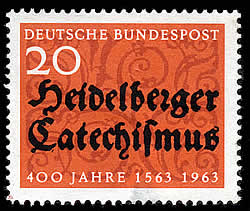
Stamps of the Heidelberg Catechism
The Heidelberg Catechism fulfilled several functions in the Electoral Palatinate. In the church services an excerpt was read every Sunday before the sermon such that the whole text was covered in a year. In lessons it served as the elementary instruction of faith. For the pastor it was the doctrinal norm subordinated to the Holy Scriptures. And it functioned as an edifying book within the family. Soon after its appearance it circulated widely in and beyond Germany. Translations into Dutch, Polish and Hungarian followed quickly. Altogether it was translated into about 40 languages. At the Dordrecht Synod in 1618/19 it was expressly appointed as confessional text.
The Heidelberg Catechism has become by far the most important German Reformed confessional text. Other German Reformed confessions have had only regional and temporally limited significance. Among them are the Nassau Confession of 1578, the Bremen Confession of 1595, the Staffort Book of 1599, the Confession of the Kassel General Synod and the Hesse Catechism from the year 1607 (which was nevertheless in use in Hesse well into the 20th Century), the Bentheim Confession of 1613 and the Confessio Sigismundi of 1614.